A web server stores and delivers web content to users over the internet, primarily using HTTP or HTTPS, while an HTTP server specifically handles HTTP requests and responses.
- Responds to browser requests by serving web resources.
- HTTP server is a type of web server focused on HTTP communication.
- Some web servers support additional protocols beyond HTTP.
Working of Web Server
When a user enters a URL, the browser sends an HTTP request to the web server, which processes it and returns the required resources to display the page.
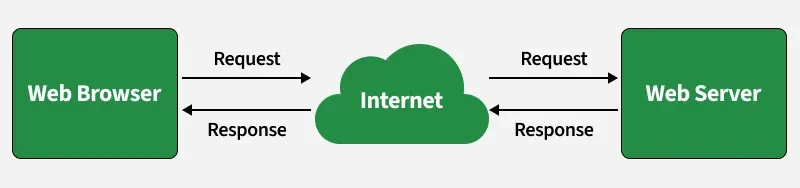
- Client Request: In the web browser(https://www.example.com/) the user enters a URL.
- DNS Resolution: The browser contacts a DNS server to obtain the IP address of the requested domain.
- Connecting to the Web Server: Using the obtained IP address the browser establishes a connection with the web server.
- Processing Request: The web server receives the request and processes it.
- Serving the Response: The requested files(HTML, CSS, JavaScript, images ) are sent back to the client's browser by the web server.
- Rendering the Web Page: Based on the received data the browser displays the web page to the user.
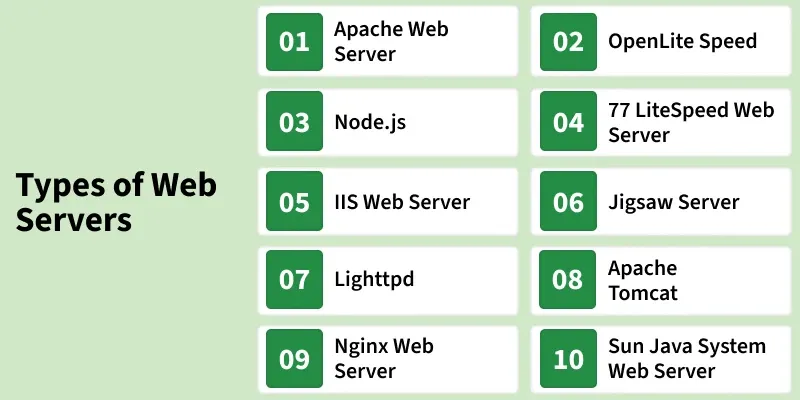
Types of Web Servers
Web servers can be categorized based on their functionality, usage, and implementation. Below are some of the most common types
1. Apache Web Server
Apache Web Server is a widely used open-source web server developed by the Apache Software Foundation. Released in 1995, it is written in C, highly customizable, and distributed under the Apache License 2.0.
- Supports multiple operating systems (Windows, Linux, macOS).
- Allows advanced routing.
- Provides directory-level configuration.
2. Nginx Web Server
Nginx (pronounced “Engine-X”) is a high-performance web server known for speed, scalability, and efficient handling of concurrent connections. Developed by Igor Sysoev and released in 2004, it is written in C.
- Designed to handle high traffic efficiently and serve static content.
- Functions as a reverse proxy and load balancer.
3. Microsoft IIS (Internet Information Services)
IIS is a web server developed by Microsoft, designed to work with Windows Server environments. It was developed by Microsoft, and first released in 1995 as a web server designed specifically for Windows-based systems. It is written in C++.
- Supports ASP.NET, PHP, and other web technologies.
- Provides built-in security features.
- Integrates well with Microsoft products.
4. LiteSpeed Web Server
LiteSpeed is a high-performance web server known for its speed and security features. The LiteSpeed Web Server, developed by LiteSpeed Technologies, and first introduced in 2003 as a high-performance alternative to Apache. It is written in C.
- Faster processing than Apache in some scenarios.
- Built-in DDoS protection.
- Supports PHP applications with high efficiency.
5. Apache Tomcat Web Server
Apache Tomcat is a web server used to run Java-based applications. Developed by the Apache Software Foundation and released in 1998, it is written in Java and works well with frameworks like Spring Boot.
- Supports Java Servlets and JSP, providing a strong environment for Java-based applications.
- Integrates well with the Apache web server for enhanced performance and scalability.
6. NodeJS Web Server
Node.js can act as a web server by directly handling HTTP requests. Developed by Ryan Dahl in 2009, it is a JavaScript runtime written in JavaScript and C++.
- Event-driven, non-blocking architecture.
- Highly efficient for real-time applications.
- Uses JavaScript for both client-side and server-side development.
7. Lighttpd
Lighttpd is a lightweight, fast web server developed by Jan Kneschke and released in 2003. Written in C, it is open source under the BSD License and runs on Windows, Linux, and macOS.
- It is optimized for low memory usage and high-speed performance, making it ideal for servers with limited resources.
- Uses asynchronous request handling, which improves efficiency and scalability for handling multiple connections.
- Supports HTTPS, FastCGI, and URL rewriting, making it a secure and efficient choice for web hosting.
8. OpenLiteSpeed
OpenLiteSpeed is an open-source web server by LiteSpeed Technologies, released in 2013. Written in C and licensed under GPLv3, it supports caching, HTTP/3, and high performance across Windows, Linux, and macOS.
- Delivers fast processing with built-in caching.
- Uses an event-driven architecture to improve performance.
- Supports modern web protocols for secure communication.
- Provides an easy-to-use interface for server configuration.
9. Jigsaw Server
Jigsaw Server is an open-source, Java-based web server developed by the W3C and released in 1996. It is mainly used for testing and developing web standards rather than production hosting.
- Jigsaw is cross-platform, running on Windows, Linux, and macOS.
- Allows users to extend and modify its functionality easily, making it flexible for research and development.
- Fully supports HTTP/1.1 and is designed for experimenting with new web technologies.
10. Sun Java System Web Server
The Sun Java System Web Server was developed by Sun Microsystems in 1996 for Java applications. Written in C and C++, it was later discontinued after Oracle acquired Sun Microsystems.
- Designed specifically for hosting Java-based enterprise applications, ensuring seamless integration.
- Handles high traffic efficiently, making it suitable for large-scale applications.
- Supports multiple operating systems, including Windows, Linux, and Solaris, for flexible deployment.
Web Servers and Their Use Cases
Choosing the right web server depends on what you need for your website or application. Here’s a simple guide to help you decide:
- Apache: Reliable and customizable for general-purpose websites.
- Nginx: High-performance server for heavy traffic.
- IIS: Best for Windows and ASP.NET applications.
- LiteSpeed: Faster, secure alternative to Apache for PHP/WordPress.
- Apache Tomcat: Ideal for Java Servlets and JSP applications.
- Node.js: Suited for real-time apps using JavaScript.
- Lighttpd: Lightweight server for low-resource systems.
- OpenLiteSpeed: Free, high-performance LiteSpeed alternative.
- Jigsaw: Used for testing and researching web standards.
- Sun Java System Web Server: For legacy Java apps (now discontinued).




No comments:
Post a Comment