A preposition is a word that shows the relationship between a noun or pronoun and other parts of a sentence. It tells us where something is, when something happens, or how things are related.
Common prepositions include words like "in," "on," "at," "under," and "with."
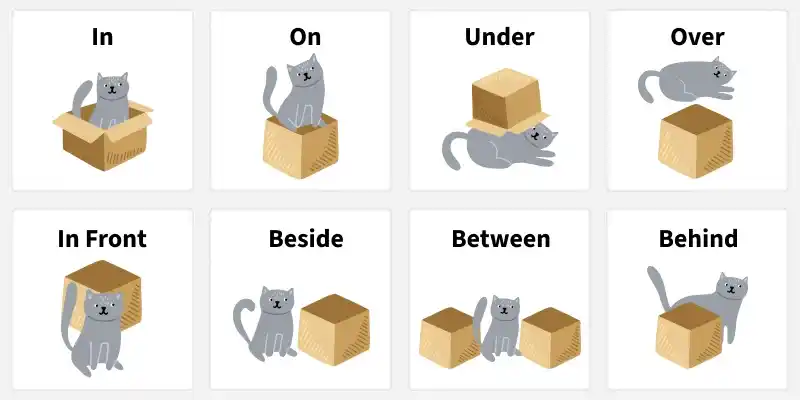
Examples in sentences:
- The book is on the table. (place)
- She will come at 5 PM. (time)
- The cat is hiding under the bed. (position)
- He walked to the park. (direction)
List of 15 Common Prepositions
Preposition | Uses |
|---|---|
| About | This preposition can be used to show an amount of time. |
| Above | It shows that something is above or higher than something else. |
| Across | This preposition indicates that one thing is on top of another. It can also be a verb to indicate the action of moving from one place to another. |
| After | This can be used before days, weeks, months, and years to show when one thing happens after another. For example: "He came to our house after seven days. |
| Around | This preposition shows the location or boundary of something or the compass direction around a place. For example, we can say, "The boy ran around his sister." It also shows the movement of a person around a place in the direction of a place or another location. For example, we can say, "The boy went around his house. |
| Apart | This indicates that something is separated from another thing. For example: "She lived apart from me" can be written as "She lived away from me." |
| At | This preposition is used to show the time when something happens. For example: "I am at your home. |
| Behind | This preposition indicates that something is behind or at the back of another thing. For example, we can say, "He came behind me in line." |
| Besides | It is used in the sentence to show that one thing is beside another. For example: "He sat beside me." |
| Between | This preposition shows the relationship between two things or people. For example: "Put the book between you and me." |
| By | It shows the position of something next to or near another thing. For example, we can say, "I saw your house from my window." |
| During | This preposition shows the period of something. It also expresses the cause of some results. For example, we can say, "What are you doing during the daytime?" |
| From | This preposition shows the direction of something from another thing or place. For example, we can say, "He came from his house." |
| In | It shows the location of something in or on top of a surface. For example, we can say, "He is in bed." |
Uses of Preposition
Prepositions are essential in the English language because they link other parts of the sentence.
i) I have a dog in my house = I have a dog that is moving around in my house.
ii) My younger brother lives in the city = It is my younger brother who lives inside the town or city.
In these sentences, the preposition has been used correctly. There is no confusion regarding part of speech, nor does it confuse anyone about what activity this person does (does he sleep in his house, for example). Another main point that must be considered is that prepositions come after adjectives. In this case, the present participle is not used.
For example:
i) To + noun:
- I am going to a restaurant = I am going toward a restaurant.
- I lied to my teacher = I lied in front of my teacher.
ii) In + noun:
- I have a dog in the house = There is a dog living or moving around with me in my house.
iii) On + noun:
- We put our desks on the ground = We put our desks on top of the floor or ground.
Types of Prepositions
Simple Prepositions: These are single-word prepositions that show basic relationships.
- Examples: in, on, at, under, over, by, with, to, from, for, of, about, through, across.
Compound Prepositions: These are prepositions formed by combining two or more words.
- Examples: in front of, because of, instead of, on top of, out of, according to, apart from.
Prepositional Phrases: These are groups of words containing a preposition and its object.
- Examples: in the park, at the table, on the roof, under the bridge, with my friends.
Time Prepositions: These prepositions indicate when or for how long something happens.
- Examples: before, after, during, in, on, at, since, for, until, by, from, to.
Place Prepositions: These prepositions indicate where something is located.
- Examples: in, on, at, by, under, over, above, below, inside, outside, between, among.
Directional Prepositions: These prepositions indicate the direction of movement.
- Examples: to, from, into, onto, out of, towards, through, across, along, up, down.
Agent Prepositions: These prepositions indicate the doer of an action.
- Examples: by, with.
Manner Prepositions: These prepositions indicate the manner or way in which something is done.
- Examples: by, with, like.
Possession Prepositions: These prepositions indicate ownership or possession.
- Examples: of, with.
Purpose Prepositions: These prepositions indicate the purpose or reason.
- Examples: for, to, with
Fill in the Blanks with Appropriate Prepositions:
Q1. You will not be able to do the work ____ yourself. You need some help ____ it.
a) by
b) with
c) to
d) over
Answer: by, with
Q2. He wants to go home ____ an urgent matter.
a) to
b) in
c) near
d) for
Answer: in
Q3. Until the light falls ____ the road, we cannot see it ________ the darkness.
a) to
b) on
c) from
d) through
Answer: on, through
Q4. He went ____ her house, but she was not there.
a) for
b) at
c) to
d) from
Answer: to
Q5. I will go ____ the airport ____ our office.
a) over
b) to
c) from
d) as
Answer: to, from
Q6. He said that he was ____ the bathroom a while ago.
a) next to
b) to
c) in
d) as
Answer: in
Q7. Please bring me a cup of coffee ____ sugar _____ it.
a) with
b) in
c) to
d) on
Answer: with, in
Q8. ___________ the weekend, my family and I went to the beach.
a) at
b) on
c) in
d) from
Answer: on
Q9. The cat jumped ___________ the couch and ran ___________ the door.
a) over, through
b) above, across
c) across, towards
d) over, behind
Answer: over, through
Q10. I need to buy some vegetables ___________ the grocery store.
a) at
b) to
c) from
d) in
Answer: at




No comments:
Post a Comment