An interjection is a word or phrase that shows a sudden feeling or emotion, like happiness, surprise, anger, or sadness. These are usually short expressions and often end with an exclamation mark (!). Interjections stand alone in a sentence and are used just to express what someone feels in that moment.
Examples:
- Oh! what a beautiful house!
- Hurray! We won the final match.
- Ouch! That hurt too badly.
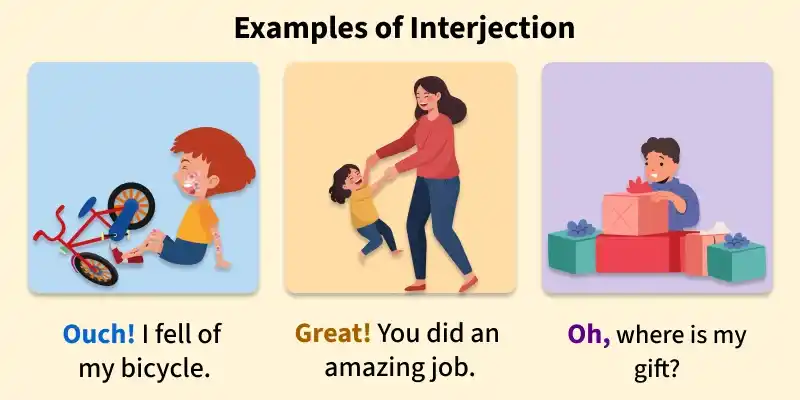
Types of Interjection
Interjections can be divided into various types, which are explained below. 1. Primary Interjection
Primary interjections are words that belong only to interjections and are not used as any other part of speech. They are used to express feelings or reactions in a sentence.
Examples:
- Wow! You had time to join us.
- Alas! I couldn’t be there on time.
2. Secondary Interjection
Words that normally belong to other parts of speech, such as nouns, adjectives, or adverbs, but are sometimes used as interjections are called secondary interjections.
Examples:
- Great! We won the match.
- Goodness! How did you go through all these 5 books in a day?
3. Mild Interjection
The words which are used for expressing mild feelings and emotions are usually called Mild Interjections. These words are typically separated from the rest of the sentence by commas.
Examples:
- Oh, He was looking for you.
- Well, it was so easy.
4. Strong Interjection
The words which are used for strong outbursts of expression are determined as Strong Interjections. Such types are typically separated from the rest of the sentence by exclamation marks.
Examples:
- Yay! I finally passed.
- Bingo! Found it.
Rules of Interjections
There are no strict rules for using interjections. However, they are most often placed at the beginning of a sentence and are commonly used to form exclamatory expressions. Some general points to remember are given below:
Rule 1:
An interjection can appear before or after a statement to show a reaction to what is happening.
Example:
- Wow! That is an incredible scene.
- What? That's something you never told me!
Rule 2:
Some interjections are used to express agreement or disagreement (yes or no).
Example:
- Yes! I'm sure I'll pull it off.
- No way are we going
Rule 3:
Some interjections are used to pause, break a thought, or gain someone’s attention in conversation.
Example:
- On the back of your shirt, um there's a stain.
- The date went meh.
List of Most Commonly Used Interjections
There are some most commonly used Interjections with examples are:
Interjections | Examples |
|---|---|
Ugh | Ugh! I can not believe how moldy the fridge is. |
Wow | Wow, nice work! I am impressed. |
Nice | A lazy morning on a Sunday, nice! |
Woohoo | Woohoo! I won the match. |
Cool | Cool! I did not know you could open a beer with your teeth. |
Win | Those shoes were only 500 rupees? Win! |
Huh | Huh! I did not know your mummy was a pilot, that is interesting. |
So | So…what did you want to speak to me about? |
Ouch | Ouch! I am not sure you should have been so honest. |
Yup | Yup, we can have that fixed for you in about an hour. |
Oh my | Oh my! Did you see how much that man looked like his dog? |
Sweet | Sweet! I shall meet you at the park tomorrow at two. |
Awesome | Awesome! We can sit next to each other on the plane! |
Hmm | Hmm, I am not sure! I think I will be able to finish that by Friday. |
Yeah | Yeah! We should try that! |
Uh oh | Uh oh, The shower is broken again. |
Oh man oh | Oh man, I spilled ice cream on my favourite coat |
Ew | Ew! You are going to eat that after it is been on the floor? |
Ahh | Ahh, I get it now. I thought you meant something else. |
Sure | Sure, You can book the tickets tonight if I want. |
Hey | Hey! How are you doing? We have not spoken in a while. |
Um | Um — I think we need to come up with a new plan. |
Ha | Ha, no it was not like that. |
Oh dear oh | Oh dear, I think I should go to bed a bit earlier tonight. |
Yikes | Yikes! That is a bit intense for a first date, isn’t it? |
Oops | Oops, I think I called that guy by the wrong name. |
Like | I am not sure. Like, maybe five or seven times? |
Jeez | He has already rung me three times today! Jeez! |
Ahem | Ahem! I am still waiting! |
Interjections vs Conjunctions
The table below shows the main differences between interjections and conjunctions.
Interjection | Conjunction |
|---|---|
Interjections are expressions that show sudden emotion. | Conjunctions are words that connect two words or two phrases. |
Do not have a grammatical function at all. | The grammatical function of joining two phrases or words together. |
Can be placed at the beginning, middle, or end of the sentences. | Should be placed considering the meaning of the sentences. |
Used mainly in informal writing. | Used in both formal and informal writing. |
Solved Questions and Answers
Direction: Fill in the blanks with a suitable interjection in the following sentences.
- ______, that is new!
- ______ That hurt me more than I thought it would.
- ______ He got the tickets to the movie premier night.
- ______ I do not want to do it this way.
- ______ You did a really big job with that piece of furniture.
- ______ now I understand what he was trying to say.
- ______ That should have upset you.
- ______ He has not cleared the internal assessment.
- ______ That was a really brave thing to do.
- _______ The waiting list for the reserved seats is too long; I do not think he would get a seat
Answers:
- Well, that is new!
- Ouch! That hurt me more than I thought it would.
- Yippee! He got the tickets to the movie premier night.
- Uh, I do not want to do it this way.
- Wow! You did a really big job with that piece of furniture.
- Ah, now I understand what he was trying to say.
- Oh no! That should have upset you.
- Alas! He has not cleared the internal assessment.
- Bravo! That was a really brave thing to do.
- My God! The waiting list for the reserved seats is too long; I don’t think we would get a seat




No comments:
Post a Comment