Conjunctions are words that join or connect other words, phrases, or sentences together. They help make sentences smoother and show relationships between ideas.
Examples: and, but, or, because, so, although, etc.
Conjunctions in sentences
- She bought apples and oranges.
- You can have tea or coffee.
- Either you call me or I will call you.
- She smiled when she saw her friend.
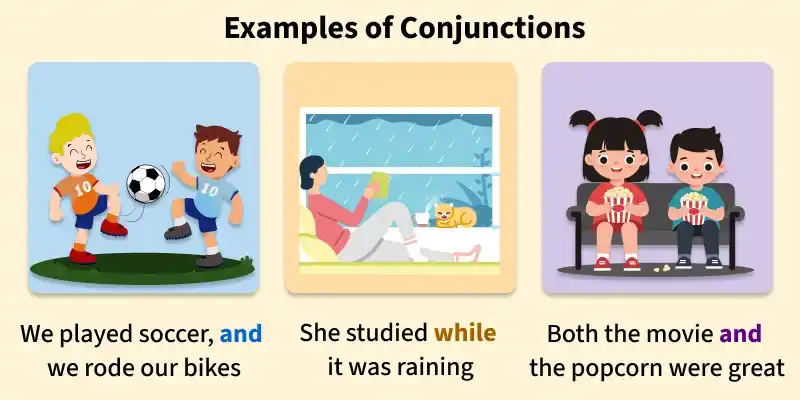
Types of Conjunctions
Conjunctions are divided into three main types based on how they connect words and ideas.
Coordinating Conjunction
Coordinating conjunctions are words that join two or more elements of equal rank in a sentence. The word “coordinating” means equal in importance.
There are seven coordinating conjunctions in English. They can be easily remembered using the acronym FANBOYS:
- F – For
- A – And
- N – Nor
- B – But
- O – Or
- Y – Yet
- S – So
Examples:
- I wanted to go outside, but it was raining.
- You can have tea or coffee.
- He was tired, so he went to bed early.
Subordinating Conjunction
A subordinating conjunction is a word that connects a dependent (subordinate) clause to an independent clause. It shows a relationship between the two clauses, such as time, reason, condition, contrast, purpose, or result. The dependent clause cannot stand alone as a complete sentence. It depends on the main clause to give full meaning.
Common Subordinating Conjunctions are-
As, because, since, if, though, although, that, before, after, till, until, as long as, when, where etc
Examples:
- I stayed at home because I was sick.
- If she comes, I shall go.
- You will pass if you work hard.
Correlative Conjunction
A Correlative Conjunction is a pair of words that work together to connect equal parts of a sentence, such as words, phrases, or clauses. Both parts of the pair must be used together to complete the meaning. Correlative conjunctions always appear in pairs and join elements of the same grammatical type.
Common Correlative Conjunctions
- either - or
- neither - nor
- both - and
- not only - but also
- whether - or
- no sooner - than
Examples:
- Either you start now or you will be late.
- Neither Riya nor Aman attended the meeting.
List of Most Commonly Used Conjunctions
Some commonly used conjunctions are as follows:
and | that | but | or | as | if | when | than |
because | while | where | after | so | except | since | until |
whether | before | although | nor | like | once | unless | now |
Solved Question and Answers
Direction: Find the errors in the following questions
Q1. (a) Sudheer put all his / (b) energy into achieving the / (c) deadlines and / (d) Pradeep could not do so.
Solution :
- There is an error in part c.
- Replace "and" with "but".
Q2. The major reason for (a) / her downfall is (b) because she did not work hard (c) / neither does she believes in her team (d).
Solution :
- There is an error in part c and d.
- Replace "because" with "that".
- Replace " believes" with "believe".
Q3. She didn't like (a) / the way that (b) / you speak to (c) / others in the class (d).
Solution :
- The error is in part c.
- Remove "speak" by "spoke".
Q4. Sheetal has (a) / lived in Delhi (b) / when I were (c) / very young (d).
Solution :
- The error is in part (a) and (c).
- “has lived” cannot be used with “when” so, remove has.
- Replace "were" with "was".
Q5. Not only he offered (a) / them some (b) / food but also he (c) / offered them clothes to wear (d).
Solution :
- There was an error in part (a).
- One should replace the first part with Not only did he offer.
Direction: Fill in the Blanks
1. Sheetal can neither read ___________ write. (nor/or)
Solution: The conjunction “neither” is always used in pair with “nor.”
This pair is called a correlative conjunction, and it is used to connect two negative alternatives.
2. __________ you work hard or face failure. (Either, neither)
Solution: Either will be the correct choice. Either/ or used in an affirmative sentence to offer a choice between two possibilities or to express a cause-effect scenario.
3. ___________ it rains, the school will declare the holiday. (Though/if)
Solution: If will be the correct choice because it shows a cause-effect scenario.
4. Parul walked carefully with her heavy loads ______ she should fail. (Lest / although)
Solution: Lest will be the correct choice because Lest should be the Subordinating conjunction.
5. _______ of being thirsty, he couldn't drink the water from the bottle. (Inspite of, in case)
Solution: “In spite of” is used to show contrast. It means something happened even though there was a reason for it not to happen.




No comments:
Post a Comment